.jpg)
ОТ РЕДАКТОРА
“In the Beginning Was the Word“: Arno Khidirbegishvili on Information Policy in Georgia
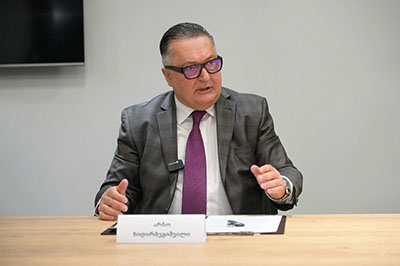 The round table "Georgia's Information Policy — What Will the Media Be Like in the Future?" took place in Tbilisi on April 22, 2026. Participants of the meeting, moderated by the Editor-in-Chief of the Svobodnaya Gruzia newspaper Tato Lashkhishvili, were invited to discuss a wide range of current media-related topics. For example: How should Georgia's information policy be transformed in the face of digitalization and the growing influence of social networks? How can the state support media independence without interfering in editorial policy? What threats (disinformation, external influence, societal polarization) are most critical for the Georgian media environment today, and how can they be countered? Can journalists and media representatives influence interstate relations?
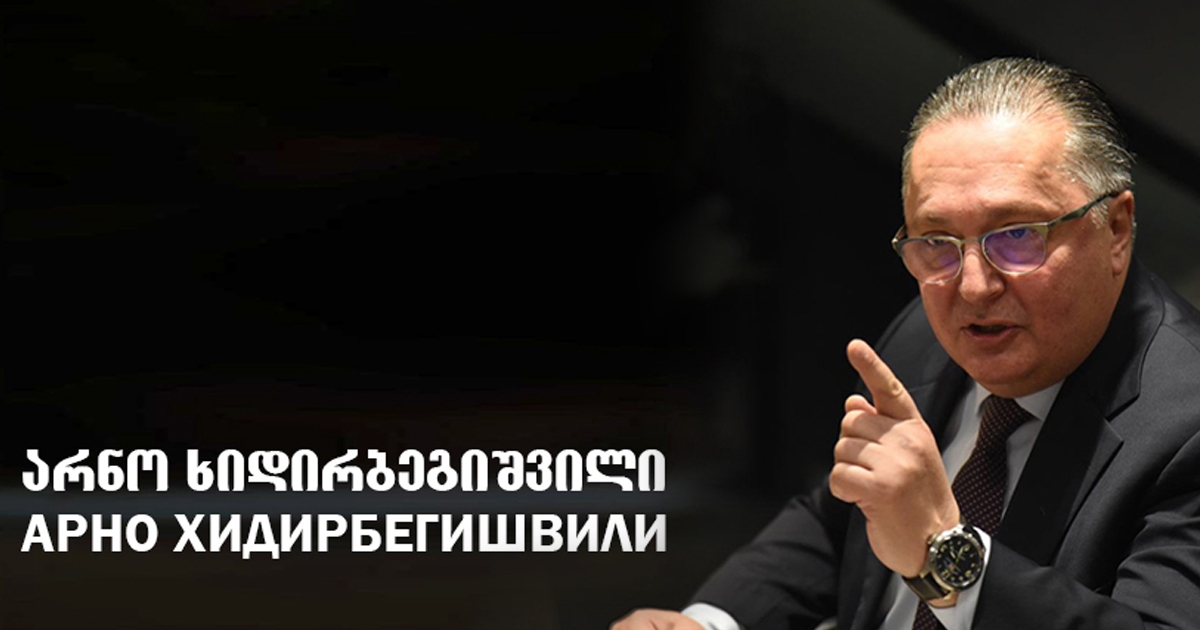
In his speech, Arno Khidirbegishvili, General Director and Editor-in-Chief of the Georgian Information-Analytical Agency "GRUZINFORM" and Director of the Center for Security, Strategic Analysis, and Information Policy, noted:
The Power of the Word and the Information War
"Participants of the Round Table know better than many others the power the Word possesses. A word can kill like a weapon, or conversely, revive. Through the Word, God speaks to us, and the feedback is our communion and prayer to God. Politicians and diplomats communicate through words even when they switch to the language of force, but wars are ended, once again, by the Word.
The ruling 'Georgian Dream' party, which replaced the 'National Movement,' initially let state information policy drift, proclaiming the slogan: 'We have no time for PR because we are busy with work' and... lost the information war to the opposition. To this day, 'Georgian Dream' remains in a defensive position; it rarely manages to seize the initiative. Opposition media are usually one step ahead, using fakes and facts for attacks, mixing truth with lies — a well-tested method.
Having restored trade, economic, transport, and humanitarian relations with Russia thanks to Bidzina Ivanishvili, 'Georgian Dream' ignored the issue of restoring media communications with the post-Soviet space — the bridge to the Russian-speaking reader and Russian society. International events organized for this purpose by the Russian side — media forums, teleconferences, master classes, competitions — did not change the overall picture, nor could they."
Integration and Digital Segregation
"It is clear that the task of recreating a unified information space between Russia and Georgia is not on the agenda today due to Georgia's integration into Euro-Atlantic structures rather than the Eurasian community. However, one gets the impression that since last week — following the 'first signs' of restoring the partnership between Georgia and the USA (referring to American visitors in Tbilisi and the Secretary of State's call to the Prime Minister) — a course toward segregation has been taken.
Russian services — Yandex, Mail.ru, Gosuslugi, VK, and many others — began blocking users with foreign IP addresses at the request of Russian regulators, warning about VPN use and demanding its deactivation even when no VPN was active. Notably, these access restrictions spread to Georgian users immediately after the shutdown of Russian information and political TV channels in Georgia — Channel One, RenTV, NTV, RTR, Russia 24, etc. — specifically starting April 16, right after the briefing by Russian Foreign Ministry spokesperson Maria Zakharova. Three random coincidences? Unlikely. Or perhaps, in a country set on restarting its strategic partnership with the US, it is undesirable to broadcast 'Vremya Pokazhet' (Time Will Tell) discussing political news? Perhaps Georgian citizens shouldn't hear the analysis of political processes in 'The Great Game' and compare it with the opinion of the Georgian political establishment? Perhaps we shouldn't watch 'Russia 24,' which covers the special operation truthfully — unlike all Georgian TV channels?"
Failure of the "Keep Enemies Close" Strategy
"Just like the aforementioned Russian events, regular meetings with media managers and journalists in Georgia yielded no results — a method practiced by Bidzina Ivanishvili during his time as Prime Minister based on the principle: 'keep your enemies closer, and your friends won't go anywhere anyway.' It subsequently turned out that this method and principle did not justify themselves. Most of them 'rose' under President Saakashvili and remained in the radical opposition camp because, as the old Georgian wisdom goes, 'it is useless to read the Gospel over a wolf's head.' Meanwhile, 'Georgian Dream' refrained from supporting friends — independent media whose editorial policy, even without government dictation, is oriented toward the positive and constructive; media deprived of foreign funding and local sponsors and not compromised by obligations to foreign intelligence services. Whether they were lazy or afraid of finally ruining already strained relations with the embassies of the US, UK, and EU no longer matters; the fact is they made a mistake and... lost again."
The "Bohemian" Media and Foreign Influence
"'Ugh, it smells like Russia here!' — say the 'combined' Georgian media craftsmen and other beau monde who are always 'in the loop' and close to those in power, though the resources they actually possess are as pathetic as their audience, whether electronic publications or cable channels where advertising announcements outweigh the content. There is no talk of editorial policy here — today, media conformists are paid for stigmatization; it sells better than state information policy or national interests inseparably linked to restoring a full-scale partnership with Russia.
And it doesn't matter that today one might face public ostracism in Georgia for outdated, routine panegyrics to the EU — are there not enough post-Soviet regimes unfriendly to Russia, say in Central Asia or next door, with whom one can profitably 'shuffle' through this difficult period until the country's policy finally settles? When there is such a comfortable niche under the authorities, when, as Fazil Iskander put it, one is 'allowed to the table' (albeit as a servant), why risk it — like that little bird that fell from the nest into cow dung, warmed up, and decided to chirp, attracting a passing fox? Isn't it better to pontificate with a smart look on global topics like the multipolar world order, East-West, North-South, the Middle Corridor, the Strait of Hormuz, and flights to the Moon?"
The Role of "Experts" and Advisors
"A 'dark role' in forming Georgia's flawed, anti-state information policy was played by so-called 'recognizable faces' — advisors, consultants, 'experts,' and other politicking elites granted access to the Glass Palace and live television. Hardened masters of intrigue who passed through the universities of Communist Party agitators, and their protégés — trained by the Soros Foundation and the 'United National Movement' — they built a breastwork around Ivanishvili from the very first days, impenetrable to creative people and ideas, to avoid competition.
The political leader and billionaire was not supposed to hear an alternative opinion or the voice of the people for as long as possible; otherwise, the need for the services of pseudo-media experts would have vanished. These 'sellers of spoiled air' would have been chased off Mount Tabor with a dirty broom, taken off the payroll, and deprived of their 'cookies' — Ivanishvili's monthly pension. I was not the only one who saw the endless lists of ungrateful people before whom 'pearls were cast'..."
Legislative Attempts and Mistakes
"Subsequently, like three of the four parties in the 'Georgian Dream' coalition (excluding Ivanishvili's namesake party), they will all scatter in different directions, leaving Bidzina Ivanishvili alone, face to face with problems. Yet, as PM, Ivanishvili practiced meetings with them — the so-called Georgian experts, whom I dubbed 'procto-politologists' for their talent for making forecasts in hindsight and interpreting events backward!
This was not the only mistake. How can one forget that the 9th Channel TV company created by Ivanishvili, which gained rapid popularity (and to which I wholeheartedly gave two leading GRUZINFORM journalists in 2012), was permanently closed six months after the victory in the October 1, 2012 elections. Consequently, a state information policy emphasizing the restoration of justice and a peaceful resolution to territorial problems faded into the background.
In its place came the policy of cohabitation with the leaders of Saakashvili's criminal regime — a condition for obtaining visa-free travel and the Free Trade Agreement with the EU. This was organically supplemented by a state info-policy popularizing 'European democratic values' and the 'no-alternative' course of Euro-Atlantic integration, which was added to the Constitution in 2018 as Article 78. Entire state information policies were 'honed' for this, commissioned from biased media at the level of village club agitators from the era of collectivization, with slogans to match: 'Forward to Europe!', 'To Europe with Dignity!'"
The Failure of "Europeanization"
"Later, when the EU presented Georgia with the 9 conditions of Charles Michel, for which Orthodox heterosexual Georgians were expected to trade the 10 Commandments — along with other instructions from the Euro and Venice Commissions, including the rejection of traditional identity, same-sex marriage registration, and LGBT propaganda — the 'dignity' with which Euro-Georgians were supposed to enter Europe was completely forgotten.
The state propaganda campaign 'To Europe with Dignity!' was forgotten as abruptly as the 'More NATO in Georgia' campaign. The anti-national subversive role of TV companies was revealed. They never became pro-government — they simply fulfilled generously paid orders for political advertising while simultaneously receiving instructions from Saakashvili, Kezerashvili, and Adeishvili. These TV companies heroized the 'Georgian Legion' and 'Azov' as the path to restoring territorial integrity. As a result, the facades of buildings in Tbilisi were covered in Ukrainian flags, and Georgian screens broadcasted 'Slava Ukraini!' — the Ukrainian version of 'Heil Hitler!'"
Current Strategy and the "Second Front"
"With a great delay, the policy of cohabitation and subsequently the policy of Europeanization were anathematized and replaced by new theses. The current state information policy is aimed at the lustration of the Western and local 'Global War Parties,' 'European Bureaucracy,' and the 'Deep State.'
The authorities tried to urgently compensate for failures in information policy by adopting several laws. First, in December 2023, the government adopted the 'Communication Strategy of the Georgian Government for 2024-2027,' prioritizing the 'Fight against disinformation and fake news.' However, because it was developed with the help of NATO and the US State Department, the strategy was originally intended to be anti-Russian.
Instead of fighting disinformation to raise public awareness, the purposeful disinformation of the population continued. Pro-government and opposition Georgian media still do not differ in their editorial policy regarding 'Russian occupation.' 'Georgian Dream' refused to open a 'Second Front,' but signed all international resolutions in support of the Kyiv junta. But the latest message from Moscow confirms my old forecast — that one day the 'Overton Window' will close and Moscow will stop accommodating Georgia's difficult position."
Funding and Strategic Communications (StratCom)
"In 2023, the UK unilaterally withdrew from the Strategic Communications Program (StratCom) in Georgia, which began in 2015. StratCom worked as a department in the Government Administration, funded by the US and UK. According to the British conclusion, the funds were used for anti-Western propaganda and PR for PM Irakli Garibashvili rather than countering 'Russian hybrid threats.' This scandal served as a trigger for Garibashvili's second resignation.
Only since 2024 has the Georgian government, through the new PM Kobakhidze and the Speaker of Parliament, begun to cautiously expose the vicious info-policy of the radical opposition and the 'European bureaucracy,' where everything negative in Georgia was attributed to Russia."
Legislative Initiatives: 2024–2026
"The authorities adopted three key laws to correct past omissions:
- 'On Transparency of Foreign Influence' (2024)
- 'On Registration of Foreign Agents' (a copy of the American FARA, 2025)
- Amendments to the Law 'On Grants' (2026)
For these, Georgia's EU integration process was suspended, and officials were punished with visa restrictions and sanctions. However, opposition media have wealthy sources of funding from Georgian businessmen hoping for Saakashvili's return, so these laws are unlikely to solve the problem—especially since they have already been amended twice to include a list of 'privileged' foreign organizations whose money 'does not smell.'"
Summary and Conclusion
"State information policy can never be a profitable media business. However, the state's direct investments in the media currently popularizing its policy cannot be called successful investments even by a stretch. We see failed tasks, defeats on information fronts, and the failure of the TV debate format, which transformed into 'private parties' for the few.
Healthy competition and equal starting conditions are necessary for an info-policy aimed at protecting Georgia's national interests. The state should not suffer from a false sense of shame in supporting media that conduct state info-policy at a professional level.
One must not deprive the 'Fourth Estate' of its main function — critical evaluation of the authorities. This is a fundamental right. At the same time, the shutdown of Russian political channels on April 16, 2026, evokes unhealthy associations with the Saakashvili regime. If providers did this on their own, it is a provocation aimed at creating tension between Russia and Georgia.
Bidzina Ivanishvili has begun government reforms to make it more relevant to new foreign policy realities. Changes will affect the government, the Tbilisi municipality, and the ruling party. During this time, any critical assessments from our 'Great Northern Neighbor' — which most people learn about from Russian TV — are undesirable, so as not to give the opposition a reason to claim that 'Georgian Dream' is 'checking its watch' with Moscow. It is now critically important that no Word interferes with Georgia and Russia maintaining an optimal status quo of unadvertised friendliness.
As I said, 'In the beginning was the Word': in my speech, I have outlined the errors in conducting information policy and the consequences resulting from its undervaluation."